
About this exercise
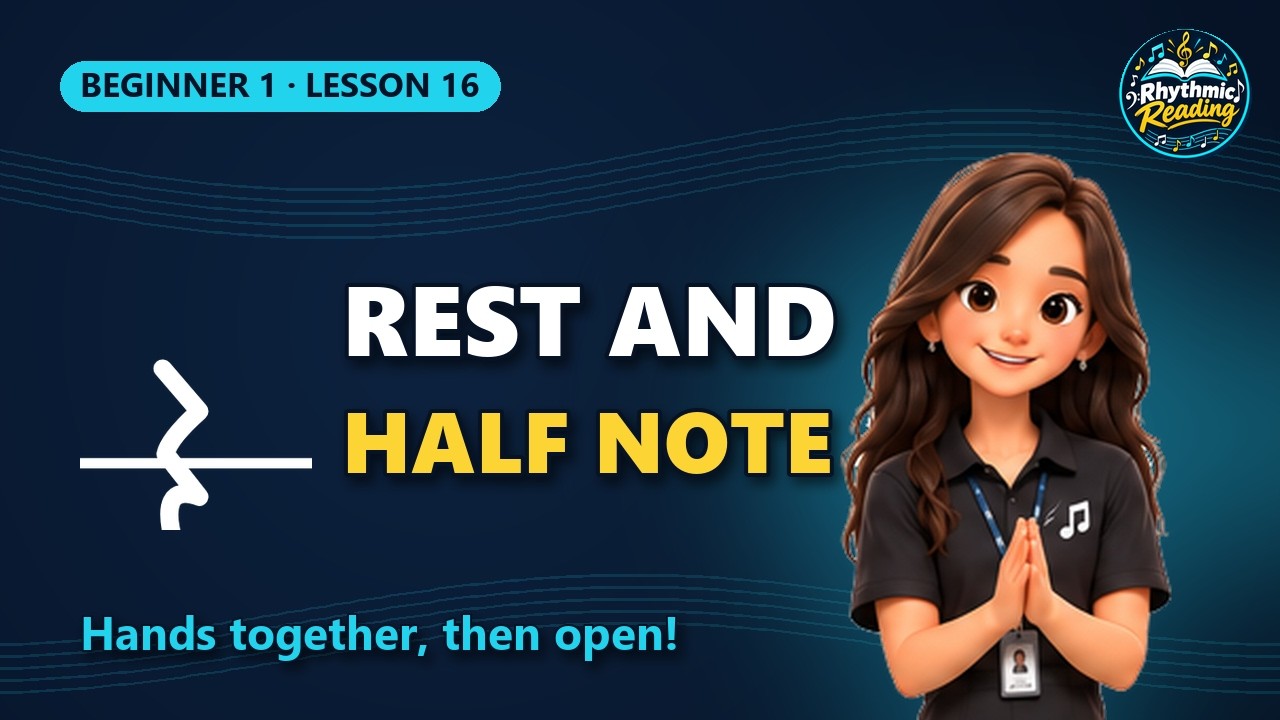
Now rests share the bar with the half note. The contrast is the heart of the lesson: on the half note your hands stay together for 2 beats; on the quarter rest they stay open for 1. In bars like "rest, clap, half note" (bar 5), all three actions come in a row: open, clap, hold.
Exaggerate these gestures at first. With practice they become natural, and reading becomes physical, not just visual: your body learns the difference between sound that continues and silence.
View Details
How to play it
- Count-in: the site counts 1 bar before starting ("1 2 3 4"). Clap the first note on beat 1 of bar 1.
- Reading: read the line on the yellow strip and look ahead to the next one: that's how you read ahead.
- Hands together: on notes longer than 1 beat (half note and whole note) clap and keep your hands together until the end of the note: hands together = the sound keeps going.
- Rests: hands open, no clapping, and keep counting in silence.
How to practice
- Say the count out loud, without clapping, looking at the Bar by bar table.
- In Together mode, count and clap at the same time as the character.
- In Your turn mode, clap on your own. If it's hard, slow down and then come back.
Bar by bar
Bold = clap · (n) = don't clap, the sound keeps going (hands together) · [n] = rest, hands open.
| Bar | Notes | Count |
|---|---|---|
| 1 | half note, quarter note, quarter rest | 1 (2) 3 [4] |
| 2 | half note, quarter note, quarter rest | 1 (2) 3 [4] |
| 3 | quarter note, quarter rest, half note | 1 [2] 3 (4) |
| 4 | whole note | 1 (2) (3) (4) |
| 5 | quarter rest, quarter note, half note | [1] 2 3 (4) |
| 6 | half note, quarter note, quarter rest | 1 (2) 3 [4] |
| 7 | quarter note, quarter rest, half note | 1 [2] 3 (4) |
| 8 | whole note | 1 (2) (3) (4) |
Notes used: whole note, half note, quarter note, quarter rest.