
About this exercise
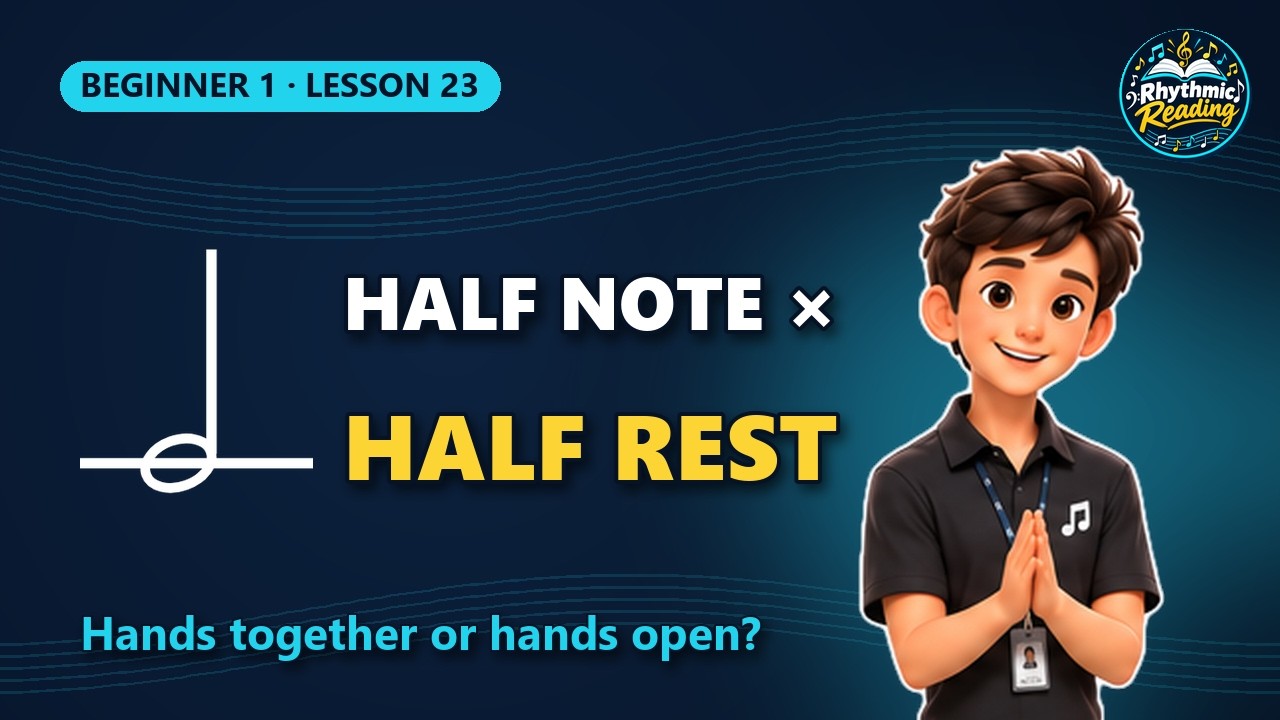
An exercise in pure contrast: the half note and the half rest swap places from bar to bar. Both have the same length and almost the same shape, but one sounds and the other doesn't. Look carefully at the white notehead with a stem (half note) and the block on the middle line (rest).
Bar 5 has two half notes and breaks the pattern on purpose, to test whether you are reading. In the bars that start with the rest (2, 4 and 7), the clap lands on beat 3.
View Details
How to play it
- Count-in: the site counts 1 bar before starting ("1 2 3 4"). Clap the first note on beat 1 of bar 1.
- Reading: read the line on the yellow strip and look ahead to the next one: that's how you read ahead.
- Hands together: on notes longer than 1 beat (half note and whole note) clap and keep your hands together until the end of the note: hands together = the sound keeps going.
- Rests: hands open, no clapping, and keep counting in silence.
How to practice
- Say the count out loud, without clapping, looking at the Bar by bar table.
- In Together mode, count and clap at the same time as the character.
- In Your turn mode, clap on your own. If it's hard, slow down and then come back.
Bar by bar
Bold = clap · (n) = don't clap, the sound keeps going (hands together) · [n] = rest, hands open.
| Bar | Notes | Count |
|---|---|---|
| 1 | half note, half rest | 1 (2) [3] [4] |
| 2 | half rest, half note | [1] [2] 3 (4) |
| 3 | half note, half rest | 1 (2) [3] [4] |
| 4 | half rest, half note | [1] [2] 3 (4) |
| 5 | 2 half notes | 1 (2) 3 (4) |
| 6 | half note, half rest | 1 (2) [3] [4] |
| 7 | half rest, half note | [1] [2] 3 (4) |
| 8 | whole note | 1 (2) (3) (4) |
Notes used: whole note, half note, half rest.